



When the Second Division becomes a reserve team league

12/03/2026 16:00:17 克里斯123
 0
0  0
0Yesterday (March 10), VFF conducted the draw and scheduled matches for the 2026 National Second Division league. The number of participating teams, 14, appears stable at first glance. Three promotion spots to the First Division next season continue to open the path upward in the professional football system. However, upon closer examination of the team list, a rather clear reality emerges: the tournament intended to initiate the development of professional clubs is being "filled up" by youth teams from the V-League.
Among the 14 teams participating in this season, as many as 5 are essentially reserve or U21 teams of clubs currently playing in the V-League, such as CAHN, Hanoi, SHB Da Nang, Ha Tinh, and Ninh Binh. Additionally, there is PVF, a youth training center well-known in the Vietnamese football system. If considered by their operational nature, nearly half of the league is essentially composed of youth teams.
The actions of V-League clubs are understandable: They decided to establish youth teams to send down to the Second Division to compete, aiming to create opportunities for exposure and experience accumulation. This idea is reasonable in a context where the national U21 league has too few matches, and a league for reserve teams has yet to be organized.
In professional football, young players need to compete regularly in a competitive environment to mature. However, the reality of the 2026 Second Division is counterproductive. With 6 out of 14 teams being youth teams or training academies, the proportion of players under 21 years old holds a dominant majority. Matches are primarily youth versus youth, of the same age group and similar immature skill level. The goal of gaining exposure becomes meaningless due to a lack of depth.
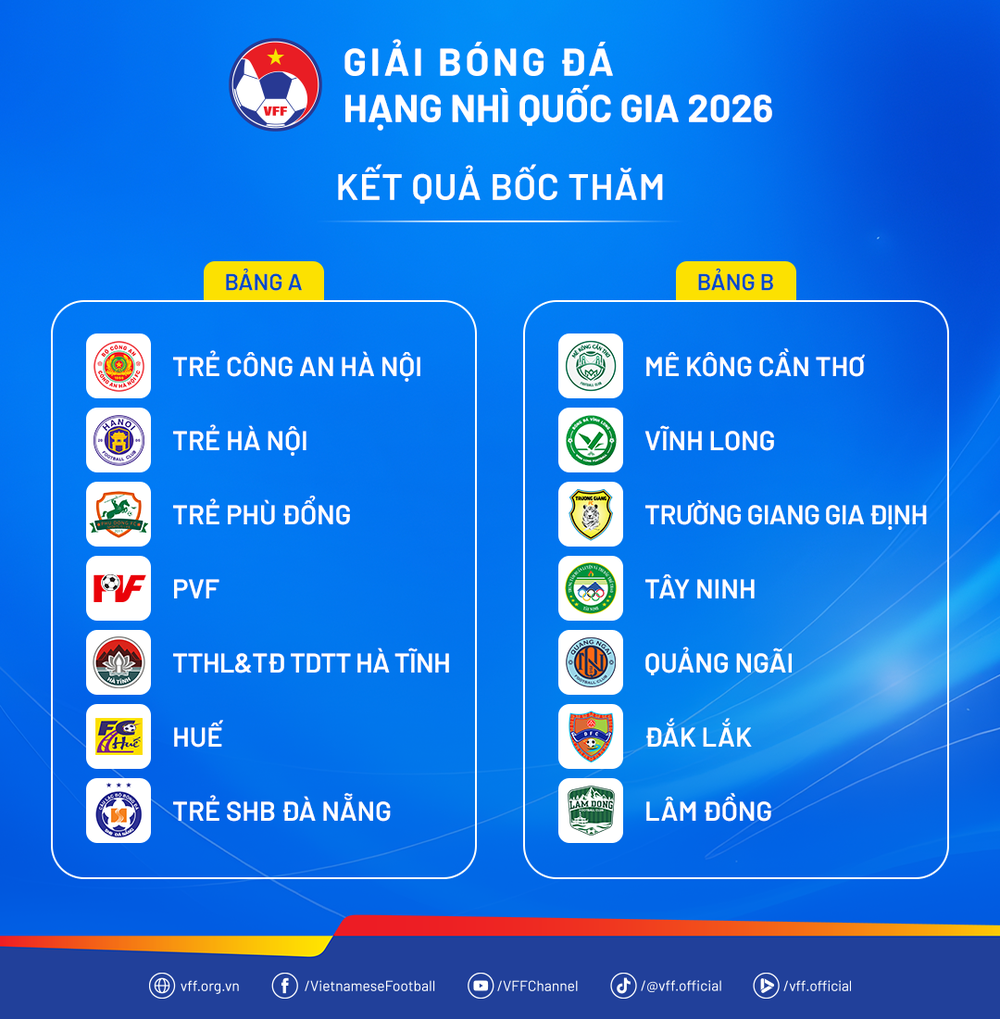
Among the 14 teams participating in this year's Second Division league, as many as 5 are essentially reserve or U21 teams of V-League clubs. Photo: VFF
It is noteworthy that VFF has made considerable efforts to boost the number of teams in this lowest-tier tournament within the professional system, by increasing the number of matches while reducing the duration of the competition period to limit operational costs.
Furthermore, allowing the use of naturalized players and Vietnamese overseas players is also a way to encourage clubs to build and familiarize themselves with professional club operations right from this lowest starting division. Yet, if we exclude the youth teams from the V-League, the number of clubs representing provinces or cities is only a handful.
As the number of local clubs decreases, the youth teams of major clubs almost fill that gap. This helps maintain the number of participating teams in the league, but it alters the nature of the competition. Both objectives of the organizers—from creating opportunities for V-League reserve players to accumulate experience, to encouraging the formation of professional clubs—are not being achieved.
Recent history has shown that the Second Division can indeed serve as a launching pad for successful club projects. Many clubs like Hanoi, CAHN, or PVF-CAND have risen from literally zero in the Second Division before quickly reaching the top tier in just 3-4 years, even swiftly winning national championships.
The only issue is that, despite the nature and the relative ease of access to professional football, it still cannot produce a number of teams double or triple the number of V-League clubs. That is the number which, theoretically, would solve the problem of both professional football and the development of young players in Vietnamese football.


Wonderfulshortvideo

mbappe news mbappe edit mbappe new shoe boot deal mbappe nike


julian alvarez barcelona news
James Trafford’s big moment in the U21 EURO final 🤯
RODRI BARCELONA transfer barcelona news today rodri to barcelona transfer here we go
gianni infantino and trump drama news
jorge messi death messi news today football news today
jose mourinho netflix documentary pep guardiola mourinho beef mourinho edit
 Links
Links
 Contact